
How to Draft Bail Application in India: Format, Grounds and Sample (2026 Guide)
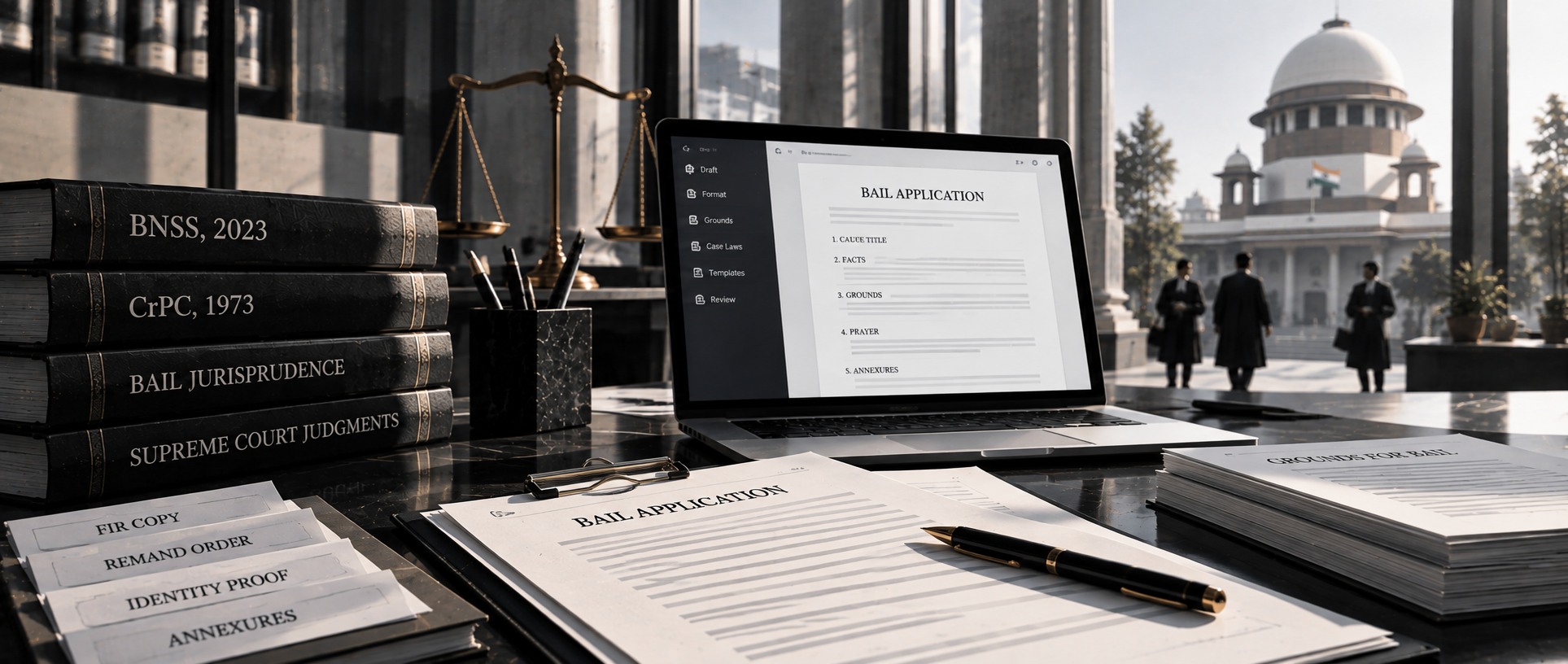
To know how to draft a bail application in India, counsel must follow five core structural parts: cause title, factual narrative, numbered grounds, specific prayer, and indexed annexures (FIR copy, remand order, identity proof).
Under the modern criminal procedural framework of the Bharatiya Nagarik Suraksha Sanhita (BNSS), 2023, file:
- Regular Bail under Section 480 or Section 483 BNSS (formerly Sections 437/439 CrPC).
- Anticipatory Bail under Section 482 BNSS (formerly Section 438 CrPC).
How to Draft a Bail Application Step-by-Step
A bail application is a short, structured legal petition. Because criminal courts review dozens of bail matters every day, precision and clarity always beat length:
- Cause Title: Name the court of competent jurisdiction (e.g., Judicial Magistrate, Court of Session, or High Court), the case type (for example, "Application under Section 483 BNSS"), the applicant, and the State. Add the FIR number, police station, and sections charged under the BNS/IPC.
- Facts: Summarise the FIR allegations in 6 to 10 succinct lines. State the arrest date, custody status, and the current stage of police investigation.
- Grounds: Number each ground. Dedicate strictly one core idea per paragraph.
- Prayer: Ask the court to release the applicant on bail on such terms and conditions as it deems fit. Add "any other relief" as a standard closing prayer.
- Annexures: List and paginate every document attached.
Save drafting time: Start from a clean, authoritative template using the Salhakar Legal Drafting Tool, then fill in your case-specific facts and grounds in minutes.
What Is the Format of a Bail Application in India?
Below is the verified skeleton and sample draft used across Sessions Courts and High Courts under the BNSS:
IN THE COURT OF THE SESSIONS JUDGE AT [DISTRICT], [STATE]

Bail Application No. ________ of 20__

IN THE MATTER OF:
[Name of Applicant / Accused]
S/o [Parentage], R/o [Address]                         ... APPLICANT

                               VERSUS

State of [State Name]
Through Station House Officer,
Police Station: [Police Station Name]                 ... RESPONDENT

FIR No.: [___] / Year: 20__
Police Station: [Police Station Name]
Under Sections: [Relevant Sections of BNS / IPC, Special Acts]

APPLICATION FOR REGULAR BAIL UNDER SECTION 480 / 483 OF THE
BHARATIYA NAGARIK SURAKSHA SANHITA (BNSS), 2023

MOST RESPECTFULLY SHOWETH:

1. That the Applicant is a law-abiding citizen residing at the address stated above and has clean antecedents with no prior criminal convictions.
2. That on [Date of FIR], the present FIR was registered at P.S. [___] alleging offences under Sections [___] BNS.
3. That the Applicant was arrested on [Date of Arrest] and has been in judicial custody since [Date of Remand Order]. The stage of investigation is [ongoing / chargesheet filed].
4. That the allegations in the FIR are false, baseless, and exaggerated, and the Applicant has been falsely implicated due to [state brief dispute or reason].

5. GROUNDS FOR BAIL:
   a. Because bail is the rule and jail is the exception (Sanjay Chandra v. CBI). Pre-trial detention cannot be punitive.
   b. Because custodial interrogation is no longer required and recovery (if any) has already been concluded.
   c. Because the Applicant has a fixed place of abode, deep roots in the community, and poses no risk of flight.
   d. Because the Applicant solemnly undertakes not to tamper with prosecution evidence or influence witnesses.
   e. That no previous bail application has been filed before this Court or the High Court [or disclose previous application details].

PRAYER:
It is therefore most respectfully prayed that this Hon'ble Court may graciously be pleased to:
a. Release the Applicant on regular bail in connection with FIR No. [___] of 20__, P.S. [___], upon such terms and conditions as this Hon'ble Court deems fit;
b. Pass any other or further order(s) as this Hon'ble Court may deem fit and proper in the interests of justice.

Place: [City]                                               FILED BY:
Date: [DD/MM/YYYY]                          [Advocate Name / Signature]
                                            Counsel for the Applicant

VERIFICATION:
Verified at [Place] on this [Date] day of [Month, Year] that the contents of paragraphs 1 to 5 are true to my knowledge and belief.
                                                            [DEPONENT]
Essential Checklist for the Drafting Advocate:
- Previous Applications Disclosure: Always mention whether any earlier bail application was filed or rejected. Concealment can get the application dismissed immediately.
- Verification & Signature: End with the verification, signature of the advocate or deponent, date, and place.
- Index of Annexures: Paginate each document sequentially with an index sheet.
What Are the Common Grounds Courts Accept for Bail?
No ground guarantees bail. Courts weigh the seriousness of the offence, the nature of the evidence, and the risk of flight or tampering. These grounds are routinely argued:
- Bail is the Rule, Jail is the Exception: The Supreme Court stressed this foundational principle in Sanjay Chandra v. CBI (2012) 1 SCC 40.
- No Criminal Antecedents: Clean record and law-abiding history of the applicant.
- Custodial Interrogation Not Required: Investigation is complete or chargesheet has already been filed.
- Fixed Residence and Roots in the Community: Low flight risk due to family ties and local employment.
- Long Incarceration: Trial is unlikely to conclude soon. See Satender Kumar Antil v. CBI (2022) 10 SCC 51, which laid down comprehensive guidelines on bail.
- Parity: A co-accused with an identical or similar role has already been released on bail.
- Medical Grounds, Age, or Being a Woman or a Minor: The proviso to Section 480(1) BNSS explicitly recognises these mitigating factors.
- Delay in FIR or Contradictions in Prosecution Case: Unexplained delay in lodging the FIR or glaring inconsistencies in witness statements.
Find Supporting Orders Fast: Search relevant High Court and Supreme Court bail precedents on the Salhakar Judgment Database.
What Is the Difference Between Regular Bail and Anticipatory Bail?
Regular bail is sought after arrest. Anticipatory bail is sought before arrest, when an individual has a reasonable apprehension of arrest for a non-bailable offence.
| Point | Regular Bail | Anticipatory Bail |
|---|---|---|
| Section | 480, 483 BNSS (CrPC 437, 439) | 482 BNSS (CrPC 438) |
| Filed | After arrest | Before arrest |
| Court | Magistrate, Sessions, High Court | Sessions Court, High Court |
| Core Relief | Release from custody | Direction to release on bail if arrested |
How Is an Anticipatory Bail Draft Different?
An anticipatory bail draft must show a reasonable apprehension of arrest. Bare or speculative fear is not enough.
Include These Extra Elements in Anticipatory Bail Petitions:
- Why the FIR is False, Exaggerated or Motivated: Point out personal, commercial, or political animus.
- Facts Showing Apprehension: Notice under Section 35(3) BNSS, police calls, visits, or raids at the applicant's residence.
- An Undertaking to Cooperate: Explicit declaration to join the investigation whenever called upon by the Investigating Officer.
- Prayer for Interim Protection: A prayer seeking interim protection from arrest until the final hearing of the bail petition.
Landmark Authorities to Cite:
- Gurbaksh Singh Sibbia v. State of Punjab (1980) 2 SCC 565: Held that the anticipatory bail power should not be hemmed in by rigid, artificial conditions.
- Sushila Aggarwal v. State (NCT of Delhi) (2020) 5 SCC 1: A Constitution Bench held that anticipatory bail protection need not be time-limited by default.
- Arnesh Kumar v. State of Bihar (2014) 8 SCC 273: Strict arrest safeguards and notice requirements for offences punishable with up to seven years of imprisonment.
Need Section Conversion? Map old IPC sections to BNS quickly with the Salhakar Law Mapping Tool.
What Documents Are Needed to File a Bail Application?
Attach these, each marked as a paginated annexure:
- Copy of the registered First Information Report (FIR).
- Arrest memo and remand order (for regular bail).
- Chargesheet or case diary extract, if available.
- Certified copies of previous bail orders, if any.
- Identity and permanent address proof (Aadhaar, Voter ID, Passport).
- Medical records, discharge summaries, or doctor's certificates (if medical grounds are raised).
- Vakalatnama and affidavit, where required by court rules.
Keep the proposed surety's ID and address proof ready for the bond stage once bail is granted.
Can There Be Bail as a Matter of Right?
Yes, in two situations under Indian criminal procedure:
- Bailable Offences: Under Section 478 BNSS (earlier CrPC 436), bail is a matter of absolute statutory right upon furnishing required bail bonds.
- Default Bail: If the police do not file the chargesheet within 60 or 90 days (depending on the statutory punishment threshold), the accused gets bail under Section 187 BNSS (earlier CrPC 167(2)).
Also check Section 479 BNSS (earlier CrPC 436A), which lets certain undertrials seek release after serving:
- One-third of the maximum sentence for first-time offenders who have never been convicted of any offence in the past.
- One-half of the maximum sentence for other undertrials.
- (Note: Section 479 does not apply to offences punishable with death or life imprisonment).
Frequently Asked Questions (FAQs)
What is the difference between regular bail and anticipatory bail?
Regular bail is granted after arrest and releases you from custody under Section 480 or 483 BNSS. Anticipatory bail is granted before arrest, under Section 482 BNSS, and directs release on bail if you are arrested.
What documents are needed to file a bail application?
You need the FIR, arrest memo, remand order, ID and address proof, previous bail orders, and relevant medical or supporting records. Add the vakalatnama and surety documents.
How long does a bail application typically take to be heard?
There is no fixed statutory period. Bail matters are usually listed within days, and Sessions or High Courts often decide within one to four weeks, depending on the file and the prosecution's response.
Can I use a template to draft a bail application?
Yes, but customise facts and grounds to your case. The Salhakar Legal Drafting Tool gives a starting template that you must review before filing.
Disclaimer: This article is for information and is not legal advice. Legal practitioners and litigants should independently verify statutory provisions and citations against official texts.