
IPC to BNS Mapping Table: Complete Section-by-Section Guide (2026)
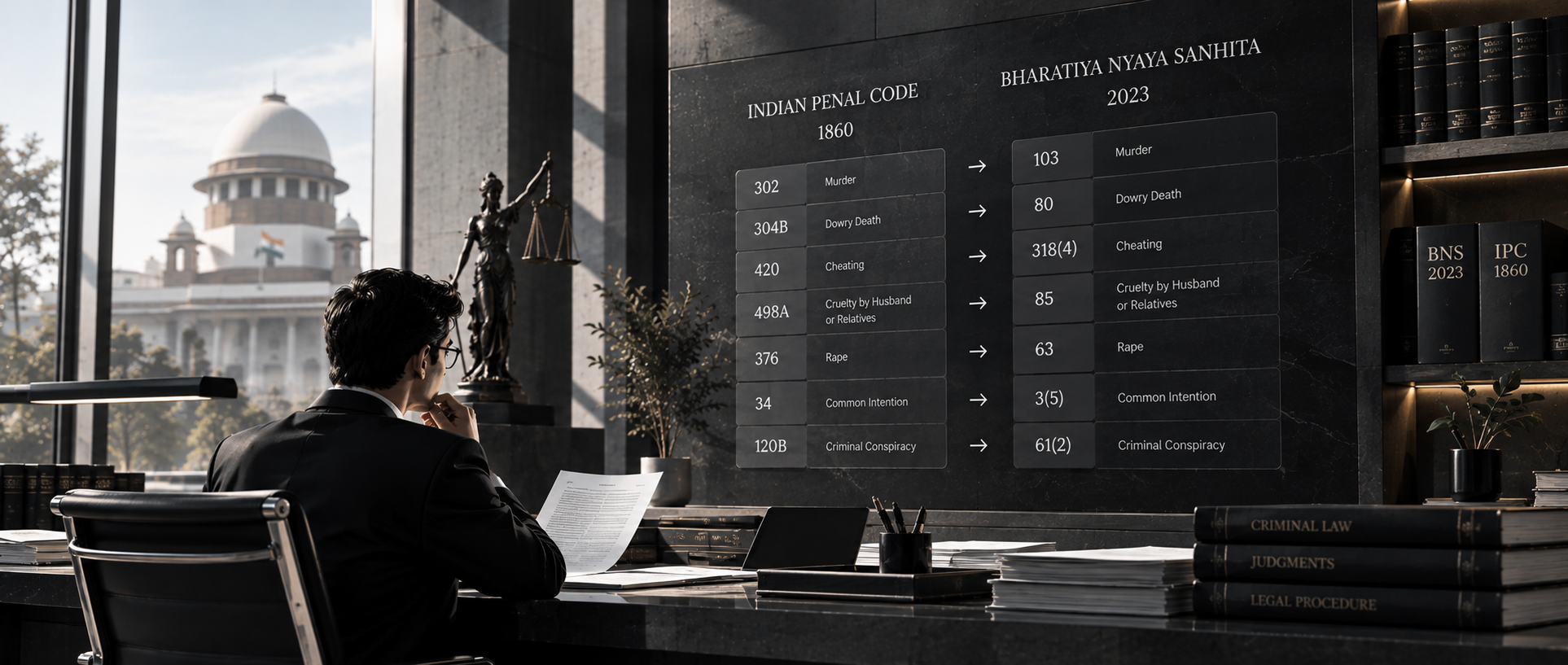
This IPC to BNS mapping table shows how the Indian Penal Code's 511 sections were reorganised into the Bharatiya Nyaya Sanhita's 358 sections, effective 1 July 2024. For example, IPC 302 (murder) is now BNS 103, IPC 420 (cheating) is BNS 318(4), and IPC 498A is BNS 85.
What Is the IPC to BNS Mapping and Why Does It Matter?
The Bharatiya Nyaya Sanhita, 2023 (Act 45 of 2023) replaced the colonial Indian Penal Code (IPC), 1860 for all offences committed on or after 1 July 2024.
However, offences committed prior to that date are still tried and punished under the substantive provisions of the IPC (as explicitly preserved by Section 358 BNS). Consequently, Indian criminal lawyers, judges, and law enforcement agencies must master both numbering systems simultaneously.
Need an instant lookup? Use the Salhakar Law Mapping Tool to convert any section instantly, and pull supporting case law from the Salhakar Judgment Database.
How Does the BNS Renumbering Work?
The BNS transition is not a simple arithmetic offset. The statute was fundamentally restructured and modernised:
- New Architectural Order: The IPC opened with offences against the State. The BNS places priority on human dignity, opening its substantive chapters with offences against women and children (Chapter V, Sections 63 to 99), followed immediately by offences affecting the human body (Chapter VI, Sections 100 to 146).
- Consolidated Definitions: Many isolated definition sections in the IPC have been consolidated into a unified interpretation section under Section 2 of the BNS.
- Sub-Section Reclassification: Punishments and aggravated forms of offences are frequently separated into distinct sub-sections. For example, simple murder is under BNS Section 103(1), while murder committed by a mob or group of five or more is codified under BNS Section 103(2).
- Consolidated Chapters: The IPC's 23 chapters were condensed into 20 chapters, eliminating redundant and colonial-era sections.
- New Forms of Punishment: Community service has been introduced for six minor offences as a reformative sentencing measure under Section 4 of the BNS.
The Complete IPC to BNS Mapping Tables
The tables below cover the most frequently cited criminal provisions across Indian courtrooms, grouped by chapter. For any section not listed here, use the Salhakar Law Mapping Tool.
1. General Principles, Abetment and Attempt
| IPC Section | Subject / Legal Concept | BNS Section | Key Changes / Notes |
|---|---|---|---|
| 21 | Public servant (definition) | 2(28) | Moved to consolidated definitions section |
| 34 | Acts done by several persons in furtherance of common intention | 3(5) | Joint criminal liability preserved |
| 96 to 106 | Right of private defence | 34 to 44 | Core doctrines of private defence retained |
| 107 | Abetment of a thing | 45 | Definition of abetment |
| 109 | Punishment for abetment | 49 | Sentence aligned with substantive offence |
| 120B | Criminal conspiracy | 61(2) | Retains prior punishment structure |
| 511 | Attempt to commit offences | 62 | Residual attempt provision |
2. Offences Against Women and Children
| IPC Section | Subject / Legal Concept | BNS Section | Key Changes / Notes |
|---|---|---|---|
| 304B | Dowry death | 80 | Mandatory minimum 7 years imprisonment |
| 354 | Assault or criminal force to woman with intent to outrage modesty | 74 | Preserved |
| 354A | Sexual harassment | 75 | Retains specific categories of harassment |
| 354D | Stalking | 78 | Physical and electronic stalking |
| 366 | Kidnapping, abducting woman to compel marriage | 87 | Preserved |
| 375 | Rape (definition) | 63 | Substantive definition of rape |
| 376 | Punishment for rape | 64 | Rigorous imprisonment not less than 10 years |
| 376D | Gang rape | 70(1) | Imprisonment for not less than 20 years or life |
| 494 | Marrying again during lifetime of husband or wife (Bigamy) | 82(1) | Preserved |
| 498A | Cruelty by husband or relatives of husband | 85 | See detailed IPC 498A vs BNS 85 comparison |
| 509 | Word, gesture or act intended to insult the modesty of a woman | 79 | Enhanced penalties |
3. Offences Affecting the Human Body
| IPC Section | Subject / Legal Concept | BNS Section | Key Changes / Notes |
|---|---|---|---|
| 299 | Culpable homicide | 100 | Core definition retained |
| 300 | Murder (definition) | 101 | Classical 4 clauses and 5 exceptions retained |
| 302 | Punishment for murder | 103(1) | See detailed IPC 302 vs BNS 103 comparison |
| — | Mob lynching (Murder by 5 or more on race/caste/community grounds) | 103(2) | New offence introduced in BNS |
| 304 | Culpable homicide not amounting to murder | 105 | Retains Part I and Part II classification |
| 304A | Causing death by negligence | 106(1) | Imprisonment up to 5 years and fine |
| — | Hit and run: Failure to report rash/negligent driving to police/magistrate | 106(2) | New offence (Enforcement held in abeyance) |
| 306 | Abetment of suicide | 108 | Preserved |
| 307 | Attempt to murder | 109 | Preserved |
| 323 | Punishment for voluntarily causing hurt | 115(2) | Community service added as alternative option |
| 325 | Punishment for voluntarily causing grievous hurt | 117(2) | Preserved |
| 363 | Punishment for kidnapping | 137(2) | Preserved |
| 364A | Kidnapping for ransom | 140(2) | Preserved |
| 370 | Trafficking of persons | 143 | Comprehensive anti-trafficking provision |
4. Offences Against Property
| IPC Section | Subject / Legal Concept | BNS Section | Key Changes / Notes |
|---|---|---|---|
| 378 | Theft (definition) | 303(1) | Definition of theft |
| 379 | Punishment for theft | 303(2) | Community service available for petty thefts |
| — | Snatching | 304 | New specific offence carrying up to 3 years |
| 392 | Punishment for robbery | 309 | Preserved |
| 395 | Punishment for dacoity | 310(2) | Life imprisonment or rigorous up to 10 years |
| 406 | Punishment for criminal breach of trust | 316(2) | Preserved |
| 409 | Criminal breach of trust by public servant, banker, or agent | 316(5) | Life imprisonment or up to 10 years |
| 411 | Dishonestly receiving stolen property | 317 | Preserved |
| 420 | Cheating and dishonestly inducing delivery of property | 318(4) | Imprisonment up to 7 years and fine |
| 441 | Criminal trespass | 329 | Preserved |
5. Public Order, Justice, Documents and Defamation
| IPC Section | Subject / Legal Concept | BNS Section | Key Changes / Notes |
|---|---|---|---|
| 121 | Waging war against the Government of India | 147 | Death or life imprisonment |
| 141 | Unlawful assembly | 189 | Assembly of five or more persons |
| 149 | Every member of unlawful assembly guilty of offence committed in prosecution of common object | 190 | Constructive liability preserved |
| 153A | Promoting enmity between different groups on grounds of religion, race, etc. | 196 | Preserved |
| 188 | Disobedience to order duly promulgated by public servant | 223 | Expanded scope |
| 193 | Punishment for false evidence (perjury) | 229 | Preserved |
| 201 | Causing disappearance of evidence of offence | 238 | Preserved |
| 295A | Deliberate and malicious acts intended to outrage religious feelings | 299 | Preserved |
| 465 | Punishment for forgery | 336(2) | Preserved |
| 499 & 500 | Defamation and punishment for defamation | 356 | Community service introduced as an option |
| 506 | Punishment for criminal intimidation | 351(2) | Preserved |
Which IPC Sections Were Removed or Merged in the BNS?
Notable omissions and structural changes from the colonial code include:
- Sedition (IPC Section 124A): The archaic offence of sedition has been completely omitted. In its place, Section 152 BNS penalises "Acts endangering sovereignty, unity and integrity of India", focusing on secession, armed rebellion, and subversive activities.
- Adultery (IPC Section 497): Struck down as unconstitutional by the Supreme Court in Joseph Shine v. Union of India (2018) 2 SCC 189, and completely omitted from the BNS.
- Unnatural Offences (IPC Section 377): The provision penalising consensual non-procreative acts has been omitted. Non-consensual acts against adult men are not currently codified as a specific sex offence under BNS.
- Attempt to Commit Suicide (IPC Section 309): The generic attempt to commit suicide has been dropped in line with the Mental Healthcare Act, 2017. However, Section 226 BNS penalises attempted suicide specifically done with the intent to compel or restrain a public servant from discharging their duty.
What New Offences Did the BNS Introduce?
The Bharatiya Nyaya Sanhita introduced several substantive offences addressing modern criminal realities that the IPC did not cover:
- Organised Crime (Section 111 BNS): Covers continuing unlawful activity by crime syndicates (extortion, contract killing, land grabbing, cybercrimes), including death penalty or life imprisonment for acts causing death.
- Petty Organised Crime (Section 112 BNS): Covers theft, snatching, cheating, ticket unauthorised selling, and card skimming committed by groups.
- Terrorist Act (Section 113 BNS): Incorporates comprehensive terrorism provisions into the general penal code, complementing the UAPA.
- Mob Lynching (Section 103(2) BNS): Specific punishment (death or life imprisonment) when murder is committed by a group of five or more acting in concert on grounds of race, caste, community, sex, place of birth, or religion.
- Snatching (Section 304 BNS): Specifically defines and penalises grabbing or seizing property suddenly and quickly.
- Hit and Run (Section 106(2) BNS): Enhanced imprisonment up to 10 years for drivers who cause death by rash/negligent driving and escape without reporting to police. (Note: Enforcement of Section 106(2) is currently held in abeyance pending stakeholder consultations).
- Sexual Intercourse by Deceitful Means (Section 69 BNS): Penalises sexual intercourse through false promise of employment, promotion, or marriage under false identity.
Frequently Asked Questions (FAQs)
How many sections does BNS have compared to IPC?
The BNS has 358 sections divided into 20 chapters. The IPC had 511 sections in 23 chapters. Many provisions were merged, modernized, or reclassified into sub-sections.
What new offences did BNS introduce that IPC did not have?
Key additions include organised crime (Section 111), petty organised crime (Section 112), terrorist acts (Section 113), mob lynching (Section 103(2)), snatching (Section 304), and sexual intercourse by deceitful means (Section 69).
Is there an official government PDF for the mapping?
Yes. The Ministry of Home Affairs (MHA) has published official comparison tables for the new criminal laws, and the complete gazetted Acts are accessible on India Code and the e-Gazette portal.
Do I still use IPC section numbers after July 2024?
Yes, for all offences committed before 1 July 2024. For offences committed on or after 1 July 2024, you must use the BNS sections, while citing relevant IPC case law where judicial principles remain identical.
Disclaimer: This article is for informational purposes only and does not constitute legal advice. While verified against official Ministry of Home Affairs tables and the Gazette of India, legal professionals should independently confirm section citations before filing court pleadings.