
Is IPC Still Applicable in 2026? Old vs New Criminal Law in India
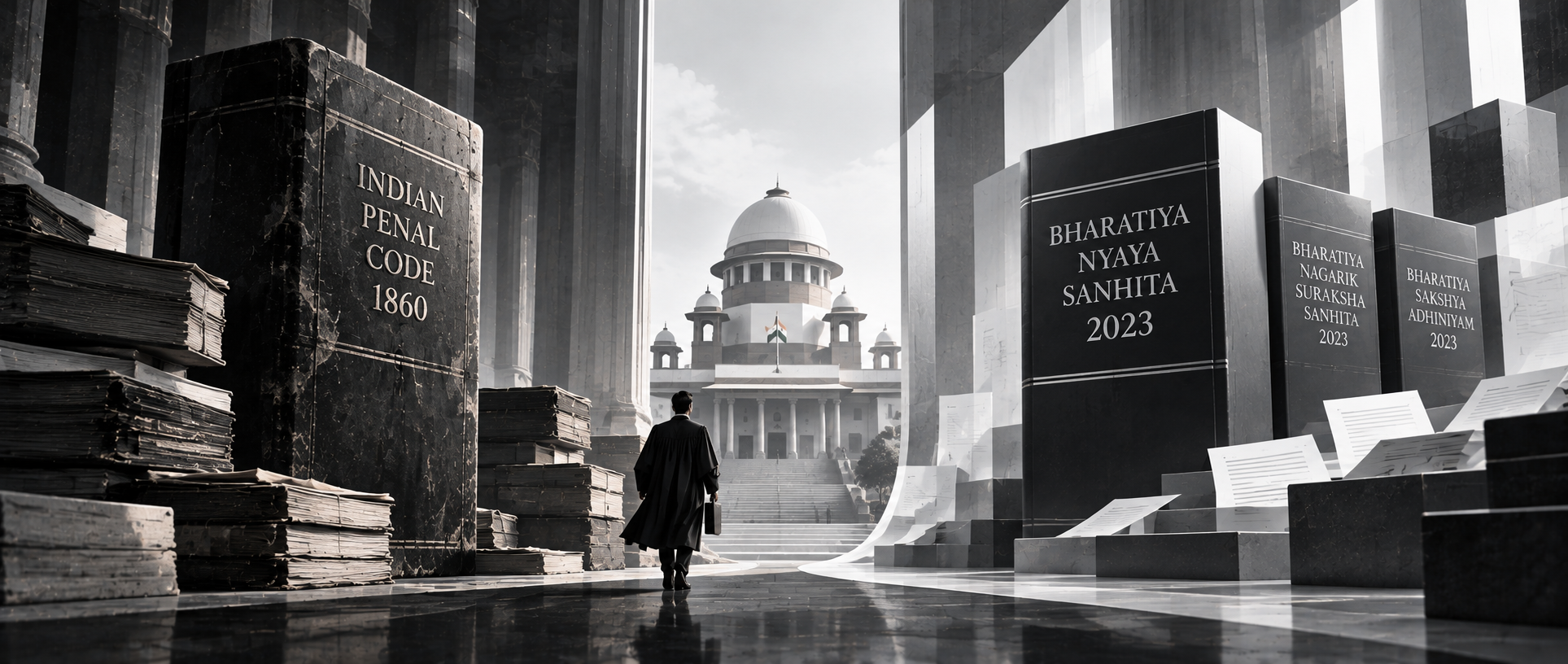
Yes, the Indian Penal Code (IPC), 1860 is still applicable in 2026, but only for offences committed before 1 July 2024. Offences committed on or after that date fall under the Bharatiya Nyaya Sanhita (BNS), 2023.
Section 358 of the BNS repealed the IPC but explicitly saved its previous operation. Consequently, old FIRs, pending police investigations, sessions trials, criminal revisions, and appellate proceedings continue under the IPC.
Is the IPC Repealed or Still Valid?
Both statements are legally accurate:
- Repealed: The IPC, 1860 stands repealed by Section 358 of the BNS with effect from 1 July 2024.
- Still Enforceable: It continues to apply to every criminal offence committed prior to that cut-off date.
Therefore, "IPC repealed" and "IPC valid for old FIRs" are not contradictory. Repeal stops the IPC from governing newly committed offences; it does not erase criminal liability for acts committed before the repeal date.
Which Law Applies: IPC or BNS?
The date of the offence is the sole deciding factor—not the date of the FIR, arrest, charge-sheet, or trial.
| Date of Offence | Substantive Law | Procedural Law (Investigation & Trial) | Law of Evidence |
|---|---|---|---|
| On or before 30 June 2024 | IPC, 1860 | BNSS, 2023 (for steps taken after 1 July 2024) / CrPC, 1973 (for cases pending on 1 July 2024) | Indian Evidence Act, 1872 / BSA, 2023 (depending on trial stage) |
| On or after 1 July 2024 | BNS, 2023 | BNSS, 2023 | BSA, 2023 |
Need to map an old charge? Not sure of the corresponding section number under the new code? Use Salhakar's IPC to BNS Law Mapping Tool to compare section provisions, definitions, and statutory penalties side-by-side.
What Does Section 358 BNS Say About the IPC?
Section 358 is the repeal and savings clause located in Chapter 20 of the Bharatiya Nyaya Sanhita (BNS), 2023. It repeals the IPC while comprehensively preserving its previous operation.
In practical legal terms, Section 358 saves:
- Anything duly done or suffered under the IPC before repeal.
- Rights, privileges, obligations, and liabilities acquired, accrued, or incurred under it.
- Penalties, forfeitures, and punishments incurred for offences committed under the IPC.
- Investigations, legal proceedings, and remedies for such offences, which may be instituted, continued, or enforced as if the IPC had not been repealed.
The statutory outcome is clear: no accused escapes criminal liability simply because the IPC was repealed.
Does the Constitution Stop BNS From Applying to Old Offences?
Yes. Article 20(1) of the Constitution of India provides fundamental protection against retrospective criminal laws (ex post facto legislation):
- It bars conviction for any act that was not an offence under the law in force at the time of its commission.
- It prohibits imposing a penalty greater than that which might have been inflicted under the law in force at the time of the offence.
That is why the BNS cannot reach back to offences committed on or before 30 June 2024. Furthermore, where a provision of the BNS prescribes a milder punishment, an accused is not automatically entitled to the lesser penalty under the general savings clause. Counsel should check the judicial position on the specific penal provision involved.
What Happens to Pending IPC Trials and Appeals After BNS?
All trials, appeals, revisions, and applications already underway continue under the IPC without disruption:
- Substantive Law: Section 358 BNS preserves the IPC for those ongoing matters.
- Procedural Law: Section 531 of the BNSS, 2023 saves the Code of Criminal Procedure (CrPC), 1973 for any appeal, application, trial, inquiry, or investigation pending as of 1 July 2024. Those proceedings are to be completed under the CrPC as if the BNSS had not come into force.
This is the cleanest statutory category: because the case was already pending on the cut-off date, both the substantive and procedural codes of the previous generation remain intact together.
What If an Old Offence Is Reported After 1 July 2024?
This scenario creates the most practical confusion among practitioners and police stations:
- Substantive Law: The IPC applies, because the offence was committed when the IPC was in force.
- Procedural Law: Courts and commentators have held that the BNSS governs FIR registration, preliminary inquiries, and investigations initiated on or after 1 July 2024. This includes procedural safeguards such as the BNSS preliminary inquiry mechanism and statutory investigation timelines.
High Courts have repeatedly dealt with petitions arguing that an old offence could not be registered under the IPC after repeal. The established legal consensus confirms that registration under the IPC is legally valid for pre-1 July 2024 offences, with BNSS procedural rules governing subsequent investigative steps.
Research Tip: Look up recent High Court and Supreme Court rulings in Salhakar's Judgment Search Database before relying on any specific transition argument in court.
Were the CrPC and the Indian Evidence Act Also Replaced?
Yes. India's criminal legal framework underwent a tripartite transformation simultaneously on 1 July 2024:
| Colonial / Previous Law | Successor Code | Statutory Repeal & Savings Clause |
|---|---|---|
| Indian Penal Code, 1860 (IPC) | Bharatiya Nyaya Sanhita, 2023 (BNS) | Section 358 BNS |
| Code of Criminal Procedure, 1973 (CrPC) | Bharatiya Nagarik Suraksha Sanhita, 2023 (BNSS) | Section 531 BNSS |
| Indian Evidence Act, 1872 (IEA) | Bharatiya Sakshya Adhiniyam, 2023 (BSA) | Section 170 BSA |
Because all three successor codes took effect on the same date, advocates managing transition-era litigation must be proficient in bridging both generations of procedural and substantive statutes.
Is It a Myth That the IPC Is Fully Dead?
Yes, that is completely a myth. While the IPC is no longer an active code for newly committed crimes, it will remain in daily courtroom use for years to come:
- Fresh FIRs for offences committed prior to July 2024 will continue to invoke IPC sections.
- Long-running trials, sessions cases, High Court appeals, criminal revisions, and Supreme Court SLPs will cite IPC provisions for the next decade or more.
- Landmark judicial precedents interpreting the IPC remain fundamentally relevant because the BNS preserves the foundational jurisprudence of most classical offences.
For example, the seminal doctrine laid down in Bachan Singh v. State of Punjab (1980) 2 SCC 684 regarding the 'rarest of rare' death penalty framework continues to apply to Section 103 BNS, the direct successor to Section 302 IPC.
Is BNS Harsher or More Lenient Than the IPC?
The transition is mixed, but overall the BNS leans significantly harsher. Key statutory shifts documented across comparative analyses include:
- Expanded Scope: Approximately 20 new offences added, and 19 colonial-era provisions omitted.
- Enhanced Sentences: Higher imprisonment terms introduced for 33 offences, and statutory fines raised across 83 offences.
- Mandatory Sentences: Mandatory minimum punishments established for 23 offences.
- Community Service: Introduced as an alternative reformative punishment for 6 minor offences.
- Sedition vs. Sovereignty: While traditional sedition (Section 124A IPC) was removed, Section 152 BNS created a new offence for acts endangering India's sovereignty, unity, and integrity.
- Unnatural Offences: Section 377 IPC has not been re-enacted in the BNS in its original form.
Before drafting bail applications or written pleadings, cross-check statutory changes using Salhakar's Law Mapping Engine.
How to Draft With Correct IPC and BNS References
When drafting criminal pleadings:
- Determine the Exact Offence Date: Confirm whether the alleged act occurred on or before 30 June 2024 (IPC) or on/after 1 July 2024 (BNS).
- Cross-Check Section Numbers: Ensure both the substantive charge and corresponding procedural applications are accurately cited.
- Automate Transition Pleadings: Use Salhakar's AI Drafting Tool to generate court-ready bail applications, quashing petitions under Section 482 CrPC / Section 528 BNSS, and written replies with verified statutory cross-references.
For a full conversion directory, visit the IPC to BNS Law Mapping Hub.
Frequently Asked Questions (FAQs)
Can a new FIR still cite IPC sections in 2026?
Yes. If the offence was committed before 1 July 2024, the FIR must cite the IPC as substantive law, even if registered in 2026. However, the procedural steps of the investigation will be governed by the BNSS.
What happens to an ongoing IPC trial after the BNS came into force?
It continues under the IPC without interruption. Section 358 BNS saves the IPC for substantive liability, and Section 531 BNSS ensures that all trials, inquiries, and appeals pending as of 1 July 2024 continue under the CrPC, 1973.
Is BNS harsher or more lenient than IPC overall?
The BNS is generally harsher. It increases imprisonment terms for 33 offences, raises fines for 83 provisions, introduces mandatory minimum sentences for 23 offences, and adds modern national security provisions under Section 152 BNS.
Was the CrPC also replaced?
Yes. The Code of Criminal Procedure, 1973 was replaced by the Bharatiya Nagarik Suraksha Sanhita (BNSS), 2023, and the Indian Evidence Act, 1872 was replaced by the Bharatiya Sakshya Adhiniyam (BSA), 2023, both effective from 1 July 2024. Section 531 BNSS and Section 170 BSA serve as their respective savings clauses.
Which code applies if an offence began before July 2024 and continued after?
Applicability depends on the nature of the offence (whether continuing or discrete) and when its essential ingredients were completed. For continuing offences spanning across 1 July 2024, courts examine the specific facts to determine whether BNS or IPC applies.