
Best AI Legal Research Tool in India: How to Choose in 2026
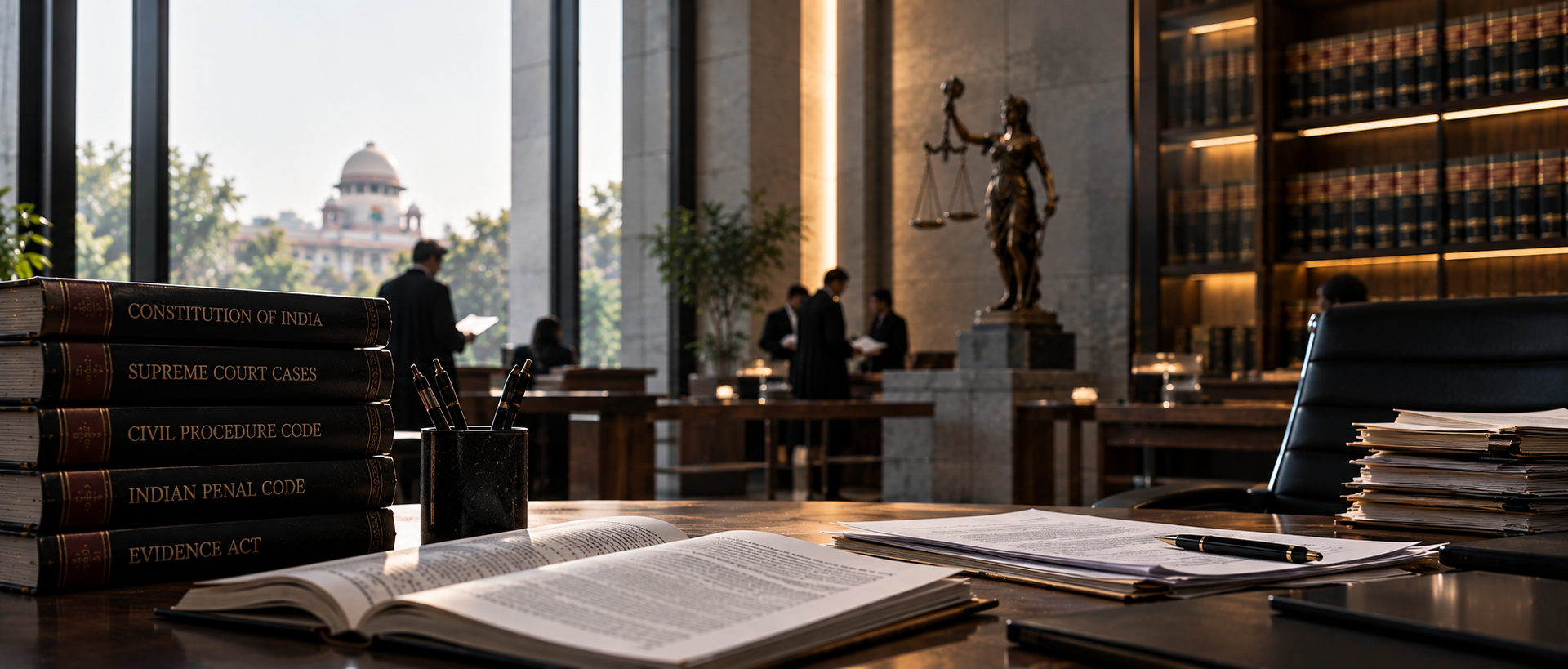
The best AI legal research tool in India is the one that fits your practice: database-first tools suit deep case-law research, while AI-first tools suit plain-language questions, automated drafting, and navigating the IPC-to-BNS statutory transition.
Salhakar is purpose-built for Indian advocates, combining 20M+ judgments, full statutory section mapping across both colonial and modern criminal codes, multilingual voice search in 15+ Indian languages, and automated legal drafting.
What Is the Difference Between an AI-First and a Database-First Legal Research Tool?
Understanding the architectural difference saves Indian practitioners hours of trial-and-error:
- Database-First Tools: Start with a massive historical library of judgments, central acts, and statutory rules. You search primarily using Boolean operators, keywords, or filters, and AI summarisation is added on top.
- AI-First Tools: Start with the lawyer's legal question. You ask complex queries in plain language, and the system autonomously retrieves authoritative precedents, synthesises ratios, and generates structured legal drafts.
Established platforms such as SCC Online, Manupatra, and CaseMine have integrated AI search assistants into their legacy databases. That makes the dividing line blurrier, so counsel should test each platform against their everyday litigation workflow.
What Features Should the Best AI Legal Research Tool in India Have?
Check these five core capabilities before committing to any platform subscription:
| Feature | What to Test | Why It Matters |
|---|---|---|
| Comprehensive Judgment Database | Supreme Court and all 25 High Courts coverage, multi-decade date ranges, and verified neutral citation links | Legal research is only as dependable as the underlying case-law corpus. |
| Bilingual Law Mapping | IPC to BNS, CrPC to BNSS, and Indian Evidence Act to BSA, with sub-section cross-references | Essential for every post-July 2024 filing, bail application, and trial proceeding. |
| Multilingual Voice Search | Speech-to-text queries in Hindi and regional Indian languages | Many Indian advocates think, discuss, and dictate arguments in their native tongue. |
| Court-Ready Drafting | Automated generation of bail petitions, written replies, notices, and quashing petitions | Saves hours of clerical drafting and eliminates obsolete colonial section citations. |
| Courtroom Simulator | Interactive mooting and trial argument testing against realistic adversarial counter-arguments | Invaluable for juniors, arguing counsel, and law students preparing for hearings. |
Salhakar delivers all five: an 20M+ Judgment Database, the IPC to BNS Law Mapping Engine, multilingual voice recognition in 15+ Indian languages, AI Drafting, and the Arjun Courtroom AI Simulator.
Is AI Legal Research Reliable Enough to Depend On?
Use AI to discover and draft faster, but always verify before you file or argue.
Every citation, quotation, paragraph reference, and statutory section must be cross-checked against the official gazette, SCC/AIR reporter, or the certified copy of the judgment. Professional codes across Indian High Courts and the Bar Council emphasize that submitting unverified or fabricated AI citations carries strict professional liability.
To safeguard your practice:
- Source Transparency: Only use legal AI tools that link every generated ratio directly to an openable, authentic judgment source.
- Avoid Hallucinatory Black Boxes: Reject tools that provide confident conclusions without exact paragraph or citation links.
- Verify Transition Law: Ensure that procedural citations distinguish clearly between pre-July 2024 IPC/CrPC steps and post-July 2024 BNS/BNSS actions.
What Is the Best AI Legal Research Tool in India for Criminal Lawyers?
Criminal practice in India currently runs on two parallel generations of law:
- Offences committed prior to 1 July 2024 are substantive matters governed by the IPC, 1860.
- Offences committed on or after that date are governed by the Bharatiya Nyaya Sanhita (BNS), 2023.
(For a comprehensive analysis of transitional FIRs and pending trials, read our guide on whether the IPC is still applicable in 2026.)
Consequently, an Indian criminal lawyer requires far more than a basic case search engine. You need:
- Instant Section Mapping: Convert classical provisions like IPC 302 directly to BNS 103, IPC 420 to BNS 318(4), and IPC 498A to BNS 85/86.
- Procedural Synchronization: Automatic cross-referencing between CrPC 1973 and BNSS 2023 provisions (e.g. Section 482 CrPC vs Section 528 BNSS).
- Dual-Code Case Retrieval: Access to High Court and Supreme Court judgments interpreting newly codified sections alongside historical precedents.
- Date-Aware Drafting: An assistant that checks the alleged date of offence and drafts pleadings citing the appropriate statutory code automatically.
Salhakar maps all 511 sections of the IPC to the 358 sections of the BNS, with comprehensive cross-references to the BNSS and BSA.
Which Indian Legal Tech Platform Covers the New Criminal Laws Best?
Several Indian platforms advertise IPC-to-BNS conversion tables. Rather than taking marketing claims at face value, test coverage directly with these five real-world checks:
- Test Complex Conversions: Check IPC 302 (Murder), 420 (Cheating), 498A (Cruelty), 120B (Conspiracy), and 34 (Common Intention) to BNS.
- Verify Specific Sub-Sections: Test whether the tool captures sub-sections, such as mob lynching under BNS 103(2) or organized crime under BNS 111.
- Check Procedural Equivalents: Verify whether Section 437/439 CrPC (Regular Bail) maps accurately to Section 480/483 BNSS.
- Search Landmark Precedents: Search for judgments applying BNS sections and assess how the tool surfaces classic IPC precedents that still govern the ratio.
- Draft a Sample Bail Petition: Generate a sample bail petition and inspect whether the AI correctly identifies pre-2024 versus post-2024 offence provisions.
Experience this directly on Salhakar's Law Mapping Tool.
How Much Does Legal AI Cost in India?
Transparent pricing is critical when evaluating legal tech. Salhakar offers flexible tiers designed for individual practitioners, growing chambers, and law firms:
| Plan | Pricing | Target User | What's Included |
|---|---|---|---|
| Free Explorer | ₹0 | Law Students & Researchers | Basic judgment search, core IPC-to-BNS mapping lookups, and AI assistant preview. |
| Pro Advocate | Starting from ₹499 – ₹1,499 / mo | Independent Advocates & Litigators | Full 20M+ Judgment Database, unlimited IPC-BNS-BNSS-BSA mapping, multilingual voice search, and AI legal drafting. |
| Chambers & Enterprise | ₹3,999 / mo or Volume Licensing | Law Firms, In-House Teams & Chambers | Multi-seat accounts, collaborative drafting, priority AI compute speed, dedicated onboarding, and enterprise security. |
Review our transparent pricing breakdown and feature matrix on the Salhakar Pricing Page.
How to Choose the Right AI Tool in 5 Steps
- Identify Your Primary Need: Clarify whether your daily practice requires deep statutory case-law retrieval, rapid legal drafting, or both.
- Verify Court and Language Coverage: Confirm that the platform indexes your specific High Court, relevant tribunals, and supports your preferred regional working language.
- Run 3 Benchmark Queries on Free Trials: Use real, complex legal questions from your active matters on each platform's trial tier.
- Audit Citation Integrity: Confirm that every sentence in an AI summary provides an inspectable link to the authentic judgment text.
- Calculate Total Annual Cost: Compare annual pricing per advocate, inclusive of GST and credit replenishment options.
Frequently Asked Questions (FAQs)
Is AI legal research reliable enough to depend on?
It is highly reliable as an accelerated research and drafting assistant, but not as a final unverified authority. Every citation, paragraph quote, and section number should be validated against the certified judgment or official bare act before being filed in court.
What is the difference between a legal database and an AI legal research tool?
A legal database stores historical judgments and statutes for keyword or Boolean query retrieval. An AI legal research tool allows advocates to ask natural plain-language questions, synthesizes legal answers from multiple authorities, and can draft court-ready pleadings directly from the analysis.
Which Indian legal tech platform covers the new criminal laws best?
Leading platforms now incorporate elements of the BNS, BNSS, and BSA. When choosing, test section-level conversion accuracy, transitional bail petition drafting, and whether the tool correctly distinguishes pre-July 2024 IPC offences from post-July 2024 BNS matters. Salhakar is architected specifically around this dual-code reality.
Can AI legal research tools work in Hindi and regional languages?
Yes, advanced platforms support multilingual voice and text queries. Salhakar supports 15+ Indian languages, enabling lawyers to research and dictate queries in Hindi, Gujarati, Marathi, Tamil, Telugu, and other regional languages while retrieving authoritative English legal precedents.