
BNSS vs CrPC FIR Procedure: Zero FIR, e-FIR, Arrest Rules and Timelines
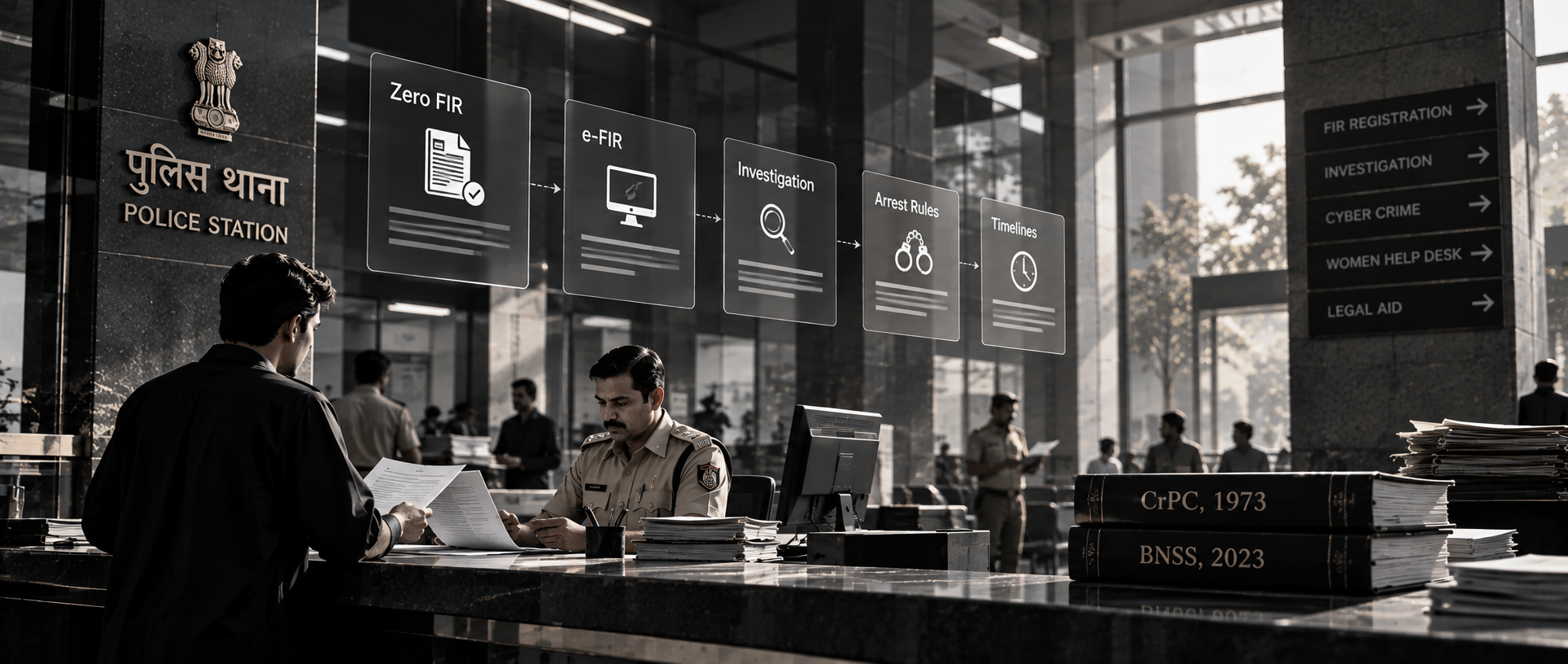
The Bharatiya Nagarik Suraksha Sanhita (BNSS), 2023 came into force on 1 July 2024, replacing the colonial-era Code of Criminal Procedure (CrPC), 1973.
Under the new procedural code, FIR registration moved from Section 154 CrPC to Section 173 BNSS. The statutory transition introduces landmark reforms: an explicit statutory mandate for Zero FIRs, formalized e-FIR mechanisms (signed within three days), an optional 14-day preliminary enquiry for mid-level offences, strict investigative timelines, mandatory forensic evidence collection for serious offences, and enhanced arrest safeguards.
What Is the Difference Between BNSS and CrPC in FIR Registration?
FIR procedure has evolved significantly from the CrPC framework to the modern BNSS:
| Procedural Point | CrPC, 1973 (Section 154) | BNSS, 2023 (Section 173) |
|---|---|---|
| Zero FIR | Judicial practice only; no explicit statutory text | Statutory mandate: Can be registered at any police station, irrespective of territorial jurisdiction |
| Electronic Information (e-FIR) | Not codified in the central statute | Formally permitted: Recorded as an FIR once signed by the informant within 3 days |
| Preliminary Enquiry | Limited judicial exceptions following Lalita Kumari (2014) 2 SCC 1 | Express 14-day enquiry for offences punishable with 3 to 7 years, requiring prior DSP permission |
| Copy of FIR | Provided free of cost to the informant only | Provided free of cost to both the informant and the victim |
| Victim Progress Updates | No mandatory statutory timeline | Investigating Officer must update the victim on progress within 90 days (Section 193) |
Need to convert a procedural section? Use Salhakar's Law Mapping Tool to instantly map any CrPC section to its corresponding BNSS provision with full legislative cross-references.
What Is a Zero FIR Under BNSS?
A Zero FIR is a first information report registered at any police station, regardless of whether the alleged crime occurred within its territorial jurisdiction. After recording the information, the police station assigns it a temporary number ("0") and forwards the case to the jurisdictional police station for formal investigation.
Under Section 173(1) BNSS, the explicit statutory inclusion of the phrase "irrespective of the area where the offence is committed" gives Zero FIRs a concrete legislative foundation for the first time in Indian statutory history.
Practical Impact for Victims and Litigators:
- Eliminates Jurisdictional Refusal: Station House Officers (SHOs) can no longer refuse to register a cognizable complaint under the pretext of territorial limits ("this does not fall in our police station boundary").
- Immediate Action for Counsel: Advocates can advise clients to lodge an FIR immediately at the nearest police station following an emergency, safeguarding vital early evidence and medical examination timelines.
What Is an e-FIR and Is It Valid Without a Signature?
Section 173(1) of the BNSS explicitly permits information regarding the commission of a cognizable offence to be transmitted to the police via electronic communication (such as state police portals, designated emails, or official mobile apps).
However, an e-FIR is not legally complete upon digital submission alone:
- Under Section 173(1) proviso, an electronically transmitted complaint is officially taken on record as an FIR only after the informant physically signs it within three days.
- If the informant fails to attend the police station and affix their signature within the 3-day window, the information remains unrecorded as a formal FIR.
Counsel should advise clients to promptly visit the police station within 72 hours of digital submission to complete statutory verification.
What Is the 14-Day Preliminary Enquiry Under Section 173(3) BNSS?
Under Section 173(3) of the BNSS, for offences punishable with imprisonment of three years or more but less than seven years, the police may conduct a preliminary enquiry before formally registering an FIR:
- Prior Permission Required: The investigating officer must obtain prior written permission from an officer not below the rank of Deputy Superintendent of Police (DSP).
- Strict 14-Day Time Limit: The enquiry must be completed within 14 days to determine whether a prima facie case exists.
- Discretionary, Not Mandatory: The police officer is not bound to hold an enquiry; they may proceed directly to regular investigation if the cognizable offence is evident on the face of the complaint.
Crucial Thresholds to Remember:
- Heinous Offences (7+ Years): The preliminary enquiry does not apply. Registration is mandatory upon receipt of cognizable information, upholding the Constitution Bench mandate in Lalita Kumari v. Govt. of U.P. (2014) 2 SCC 1.
- Petty Offences (Under 3 Years): Section 173(3) does not authorize a 14-day enquiry; the police must register the FIR or act as per non-cognizable procedures.
If the police refuse to register an FIR after an enquiry, Section 173(4) allows the aggrieved person to escalate the complaint in writing to the Superintendent of Police (SP), and subsequently approach the jurisdictional Judicial Magistrate under Section 175(3) BNSS (formerly Section 156(3) CrPC).
What Are the Timelines for Filing a Chargesheet Under BNSS?
The statutory timeline governing default bail under Section 167 CrPC is preserved in Section 187 BNSS:
| Timeline | Section | Statutory Requirement |
|---|---|---|
| 90 Days | Section 187(2) | Investigation period for offences punishable with death, life imprisonment, or 10+ years imprisonment. Failure to file charge-sheet entitles accused to default bail. |
| 60 Days | Section 187(2) | Investigation period for all other offences before default bail rights accrue. |
| 2 Months | Section 193(2) | Mandatory completion of investigation for rape and sexual offences against women and children. |
| 90 Days | Section 193(3)(ii) | Police must inform the informant/victim of investigation progress within 90 days. |
| 90 Days | Section 193(9) | Further investigation must be concluded within 90 days, unless extended with court permission. |
Police Custody Window in Section 187(2):
Section 187(2) BNSS permits police custody of up to 15 days, which may now be authorized in whole or in parts during the first 40 or 60 days of the overall 60/90-day detention period, departing from the rigid first-15-days rule under the old CrPC.
Need to file for bail? Draft statutory default-bail and regular bail petitions with verified statutory citations using Salhakar's AI Drafting Tool.
Is Forensic Evidence Collection Mandatory for Serious Offences?
Yes. Under Section 176(3) BNSS, for every offence punishable with imprisonment of seven years or more, the visit of a forensic expert to the crime scene is mandatory. The forensic expert must inspect the scene, collect samples, and the entire evidence collection process must be videographed on mobile phone or electronic device.
Note on Implementation: The Section 176(3) forensic mandate becomes operative within five years from a date notified by respective State Governments, ensuring states have adequate forensic infrastructure. Once notified in a state, failure to follow forensic protocols provides strong defense cross-examination points.
Additionally, Section 105 BNSS mandates audio-video recording of all search and seizure operations, including the preparation of the seizure memo (panchnama).
How Has Arrest Procedure Changed Under BNSS?
Arrest procedure is codified across Sections 35 to 62 BNSS (replacing CrPC Sections 41 onwards). The statutory text incorporates and formalizes landmark safeguards from D.K. Basu v. State of West Bengal (1997) 1 SCC 416 and Arnesh Kumar v. State of Bihar (2014) 8 SCC 273:
| Safeguard | BNSS Provision | Statutory Mandate |
|---|---|---|
| Notice of Appearance | Section 35(3) | For offences punishable with imprisonment of less than 7 years, police must serve a notice of appearance instead of making an arrest, unless statutory necessity warrants arrest. |
| Elderly & Infirm Protection | Section 35(7) | For offences carrying under 3 years imprisonment, no arrest of a person over 60 years or infirm can be made without prior DSP permission. |
| Police Identification | Section 36 | Arresting personnel must bear accurate, visible, and clear identification tags. |
| Designated Police Officer | Section 37 | Every district and police station must prominently display names and arrest details of arrested persons for public awareness. |
| Right to Legal Consultation | Section 38 | Arrested persons have the right to meet and consult an advocate of choice during interrogation (though not throughout). |
| Handcuffing Restrictions | Section 43(3) | Handcuffing is restricted to specific serious categories (repeat offenders, escape risks, terrorists, and heinous violent crimes). |
| Mandatory Grounds & Bail | Section 47 | Police must immediately inform the arrested person of the exact grounds of arrest and their right to bail. |
| 24-Hour Production | Section 58 | Compulsory production before the nearest Judicial Magistrate within 24 hours of arrest. |
Search judicial applications of these safeguards in Salhakar's Judgment Search Database.
What Does This Mean for Police and Litigators Day-to-Day?
For Police Officers:
- Increased documentation, electronic record-keeping, and DSP permissions for preliminary enquiries.
- Mandatory 90-day progress updates to victims and mandatory videography during search, seizure, and forensic investigations.
For Defense Advocates & Litigators:
- Lodge Zero FIRs Confidently: File complaints at any station regardless of jurisdiction to preserve immediate evidence.
- Monitor the Punishment Bracket: The statutory penalty decides whether a preliminary enquiry (Section 173(3)), notice of appearance (Section 35(3)), or forensic visit (Section 176(3)) applies.
- Track Default Bail Dates: Calculate the 60 or 90-day chargesheet clock strictly from the date of initial remand.
- Plead Statutory Non-Compliance: Lack of Section 35 notice or failure to record grounds under Section 47 provides strong grounds for bail and quashing petitions under Section 528 BNSS.
- Cite the Correct Code: For cases where the FIR was registered prior to 1 July 2024, proceedings continue under CrPC, 1973 (see our guide on whether the IPC is still applicable in 2026).
Frequently Asked Questions (FAQs)
What is a zero FIR under BNSS?
A zero FIR is an FIR registered at any police station regardless of territorial jurisdiction. Under Section 173 BNSS, the station records the complaint and immediately transfers the case file to the competent jurisdictional police station.
What is the new timeline for filing a chargesheet under BNSS?
Section 187 BNSS retains default bail limits: 90 days for offences punishable with death, life imprisonment, or 10+ years, and 60 days for all other offences. Investigations into sexual offences against women must be completed within 2 months under Section 193(2).
Is forensic evidence collection now mandatory for serious offences?
Yes. Section 176(3) BNSS mandates crime scene inspection and evidence collection by a forensic expert with videography for offences carrying 7 years or more imprisonment, subject to state government rollout within five years.
Is an e-FIR valid without the informant's physical signature?
No. Under Section 173(1) BNSS, an electronically transmitted complaint is taken on record as an official FIR only after the informant attends the station and signs it within three days.